
Why you should have a startup done
We are talking about a pool startup that is done when you resurface your pool or build a brand new pool. We are very passionate about start-ups because we do a-lot of them, so we could tell the difference when a start-up has been done or not, we do pool service miami. So here we go when a newly plastered pool is filled with water, the plaster is very vulnerable. Plaster has many different components, a certain percentage of it being calcium hydroxide. Calcium hydroxide is the weakest part of the plaster.
When unbalanced water enters the pool it immediately starts pulling that calcium hydroxide out of the plaster. The calcium hydroxide turns into dust. This from the beginning weakens the plaster. Not only that, that dust falls back on top of the plaster and could mask the color of the plaster by adhering permanently to the top of the plaster while it is curing.
One of the goals of a startup is to get rid of that plaster dust as soon as possible. So it doesn't adhere to the surface. So a must is to balance the water as soon as the pool starts getting full. Orenda technologies which is a pool chemical company. Has something called the start-up barrel. What it essentially does is pretreat the water before it starts going into the pool. This pretreatment balances the water so it doesn't have a chance to start pulling calcium hydroxide from the surface. The barrel is a bit expensive, but they have realized how important it is to have the water balanced before it entering the pool. They kind of almost guarantee no plaster dust from the start.
Alot of companies don't have the startup barrel but a start-up is still needed. A start-up barrel is ideal, but what can we do. The goal is to have the water balanced as soon as possible.
Things you want to look out for as a homeowner.
If your having a brand new pool built from scratch. You want to make sure that the shotcrete (the base concrete of the pool, the bare concrete). That when the shotcrete is done that they let it cure for 28 days before starting to do the plaster. That they wet cure it meaning a mist system or its watered daily. Wet curing it prevents shrinkage cracks, it makes sure the concrete reaches the highest compressive strength possible. By it reaching the required compressive strength, it ensures that the concrete can resist soil pressures, supports the pools finishes, prevents leaks and can handle daily use.
Not properly wet curing the shotcrete can reduce its compressive strength substantially. Believe 30% right off the bat. Shotcrete is shot at 4,500 psi. There has been cases where a shotcrete shell hasn't been cured properly and they tested a few of these and they had 1250 psi only. More than half of what it is shot at, meaning way less strength. All these cases they've had to redo the shotcrete. Especially if your near water, you need as much strength in your shotcrete as possible so when the water table rises. Wet curing strengthens the shotcrete completely and towards the 28 day mark it creates an envelope so to speak and the concrete binds really hard together.
A-lot of builders don't wait these 28 days because they want to move on to the next project but it is critical. A-lot of them also don't even do the wet curing process. Which is extremely important. Also, if the builders don't wait the 28 days for the shotcrete to cure, this could cause hydration stains on your plaster. The same as if they are replastering your pool and fix an area around your main drain underneath the plaster, and they don't let that area that was patched with hydraulic cement cure for 7 days that can cause hydration stains as well.
What happens is un-cured concrete will let moisture out. That moisture could come out and show up on your plaster. What happens is that moisture pushes through the plaster pushing the weakest part of the plaster (calcium hydroxide) out of the plaster and could cause localized scale right there causing a hydration stain. There is no chemical that can take out a hydration stain. The only way is to empty the pool and do something called torching. So that's why you also want to be on top of your builder to make sure before applying the plaster that everything underneath is cured a 100% and that any on the shell is completely dried. That there is no water anywhere. Picture below is what a hydration stain looks like.

Continuing on with the start up process
So yea you want the water to be perfectly balanced for the best outcome. Also, on a startup a-lot of times a sequestrant is used. Orenda uses Sc-1000. What this does, is it binds with calcium and holds it in solution just in case there's any part in the water that has not reached balance so the calcium doesn't scale. Just in case there is any moisture behind the plaster, SC1000 is great at helping with hydration stains. Because when the water pushes through to the plaster and pushes calcium hydroxide out of the plaster it binds to that calcium and keeps it in solution so it doesn't scale causing a hydration stain. Yea the water is balanced but there could be parts that aren't completely balanced yet, so the SC1000 will help a-lot if water is pushing calcium hydroxide out of the surface, It will catch it and keep it in solution because the scaling of that calcium hydroxide is what will cause that permanent hydration stain. A hydration looks like a shadow on your surface and it will not come off unless you torch the plaster.
So you also want to do a startup so that while the plaster is curing that any dust or dirt that falls in the pool doesn't adhere permanently to the surface. Also, once the pool is full of water you want to make sure the pump is running immediately. You do not want to wait. So, water is circulating and filtering everything out. Wouldn't be a bad idea to have an extra filter on hand as well. So, if the company doing the start up does not have a start-up barrel, changing out to a new filter can help eliminate the plaster dust as soon as possible. As part of the protocol brushing should take place 2 times a day for the first 28 days so nothing adheres to surface and also to make the surface as smooth as possible. Which is another reason why a startup should be done so that the surface comes out as smooth as possible. The goal is to be the same smoothness as an eggshell more or less.
As part of the start-up process you don't want chlorine added till the 3 day. In part because it gives you time to remove metals from the water if there is any. Because chlorine can oxidize the metals in the water and cause the metals to fall out of solution and stain the plaster. Also, because chlorine has a high PH and if there is a potential for a hydration stain chlorine could help one form. Since chlorine has a high PH if water pushes through the plaster pushing calcium hydroxide out of the plaster and chlorine is added since chlorine has a PH it could cause the calcium hydroxide to scale causing a hydration stain right then and there.
Things We've Noticed
We do lots of startups for different builders. We notice a-lot of the times builders fill the pool without having the equipment working (pool pump etc.). This is a big no, no. Not having circulation the moment the pool is filled will ruin your startup/ plaster. You need proper circulation so the water is mixed around and all of the water is balanced. So everything is washed away as well. No matter how well you balance the water if it is stagnant, all of the entire body of water will not be balanced causing major issues. You need the pump running as well so immediately any dust from construction can be brushed and the filter can pick it up and it is not left on the surface.
We've noticed that on colored surfaces the plaster dust looks yellow. If you do not take care of the plaster dust on a colored surface as soon as possible it could stick and look like algae. We have followed up on colored plaster resurfaces and have seen this happen a-lot from not doing a start-up. It is something else to look out for because not only does it obscure the color but it looks like algae.
Things You Could To Do Help Make Sure The Surface Comes Out Great.
We see this a-lot make sure any deck work that needs to be done, is done before the pool is plastered or done after the start up is done (28 days after being plastered). We see this a-lot and it doesn't make sense. A-lot of times customers have the pool resurfaced or built and after the pool has just been plastered. They'll have someone the next day come in and pressure wash the deck around the pool and reseal the deck etc.. Don't know how it makes sense to any one. You just had your pool resurfaced. Where is that dirt from the pressure washing going to go?. Straight into the pool on your new surface, and that surface is curing. It is going to absorb a-lot of that dirt and cure with it unless you an amazing job cleaning it and balancing it right after.
Or the dirt may be heavy enough where you can't get it off and it could quickly adhere to the surface. Just doesn't make any sense. Blows our minds. Why would people do that. Also make sure the builder is completely done doing stuff around the pool. The plaster should be the last thing done before the project is completely done. Make sure the builder doesn't go around fixing small things on the coping or the deck. All hat can create dust or construction debris, which can all fall in the pool. Before the plaster is put in, everything else should be a 100% done.
What you can't do
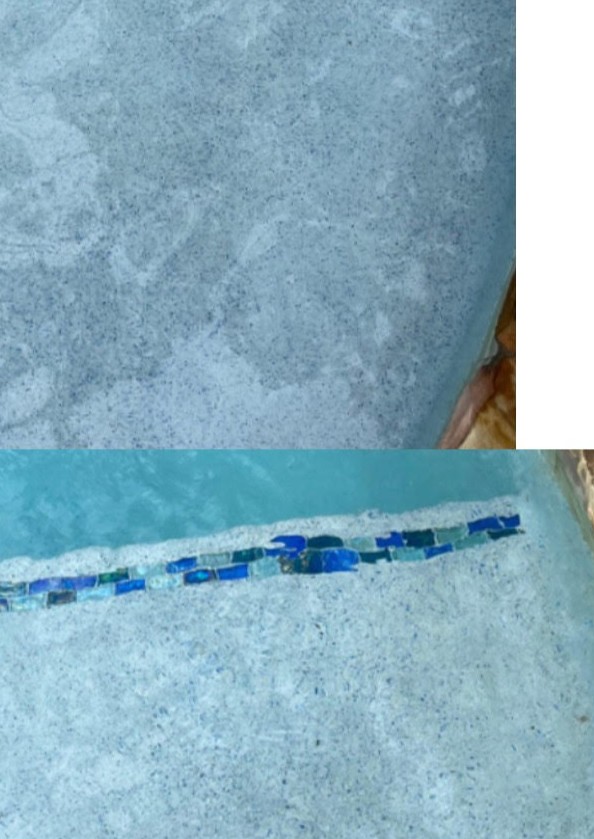
No use of the pool for the first 30 days after the pool is built. No use of wheeled vacuums for the first 30 days. No use of a metal brush for the first 30 days. And no adding of salt for the first 30 days. Stepping in the pool in the first 30 days could leave permanent foot prints. Wheeled vacuums could leave permanent marks. And salt is to corrosive to add to the pool the first 30 days. Can't see it to well below but those are pictures of footprints on the plaster from the pool being used to soon. We have more severe cases but we need to go out and take some pictures of those pools. This is the only one we had.