
Pool Filters
So lets start with the basics. There are 3 main pool filter types? D.E. filters, sand filters and cartridge filters. Lets talk a little bit about each.
D.E. Filters
D.E. filters are diatomaceotous earth filters. It is a filter with what they call grids and Diatomaceous earth is added to it. These filters can filter out about 1-3 microns. Making them the filter that picks up the finest particles of all 3 filters. It is a great filter if you want better water clarity. The only thing is cleaning them can be cumbersome because taking them apart and putting them back together can be hard sometimes until you get the hang of it. But you do not have to clean them as often as cartridge filters, every 4-6 months is recommended. Depending on the use of the filter.
You have to be careful though to use the right amount of D.E. because if you use to much it could backfire on you. Because yellow mustard algae is a diatom. Meaning diatomaceous earth has yellow mustard algae in it. But the right amount and the filter makes the water crystal clear and you've got a great filter helping you with the maintenance of your pool. If you add to much D.E. you can do the opposite and create mustard algae. We do pool maintenance in South Florida and we have taken over a few accounts where we have had to clean the filter housing extensively because to much D.E. had been added and by taking out alot of the extra D.E. powder, believe it or not we've been able to get rid of some algae from these pools. Also you want to make sure you wear a mask while adding D.E. to your filter because D.E. powder can cause cancer if inhaled on a consistent basis.
Sand Filters
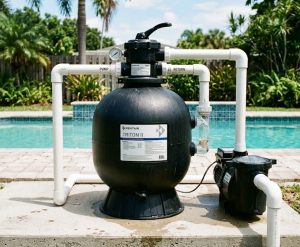
Sand pool filters we are sure you've seen them around. Like the name they use sand to filter the water. Water comes out from the top of the filter like a spout and drops down to a sand bed. The water goes through the sand bed until it gets to some tubes on the bottom (called laterals), those tubes have tiny holes that return the filtered water back to the pool.
The sharpness of the sand is what filters the water. It is recommended based on the use of the pool that the sand in a sand filter be replaced every 5-7 years. Because the sand becomes dull eventually and can't filter anymore. Sand filters pick up as low as 30 microns. Meaning they do not pickup fine particles as a D.E. filter does. We could definitely tell the difference between a pool with a D.E. filter, and cartridge filter and one with a sand filter. In a pool with a sand filter you could notice a little bit of fine dust sometimes on the surface no matter how much you vacuum.
Some pool owners prefer sand filters because to clean them you just have to backwash them every so often. Instead of taking the filter apart and having to clean it like you do a cartridge filter and D.E. filter. But its kind of the lazy way of caring for your pool because a cartridge filter or D.E. filter to use makes a big difference in how your pool looks. We prefer D.E. or cartridge over sand filters any day of the week. Also the sand filters, when you back wash them it unbalances your water because your getting rid of chemicals from your pool when backwashing.
Many people don't know but you could make a sand filter, filter better by using glass media instead of sand. So you could fill your sand filter with glass media instead of sand. Glass media filters down to about 1-3 microns. Which is a huge difference compared to 30 microns from sand. The only bad thing is, is that glass media is about double the price of sand. But to us, it is totally worth it. Because on the back end you'll save money on chemicals. The more stuff your filter picks up, the less your chlorine has to be used to oxidize contaminants etc..
Also when it comes to replacing the sand in your sand filter it is always a good idea to replace the laterals and all internals actually so you don't run the chance that later on down the road those internals break causing sand to go back into the pool. By the time you do your first sand replacement those plastic internal components have been there for a while. So who knows if they are at there break point and give way a few months after you replaced the sand. That wouldn't be good because you have to open up the filter again.
Mid Size sand filter
Cartridge Filters
Probably the most common types of filters around. In Florida they are usually one filter per pool more or less which is what they call bullet filters. Some bigger pools or higher debris pools they have four cartridge filters in one housing, which are called quad filters. Cartridge filters pick up up to as low as 10-15 microns. And from some manufacturers mouths they say its good to build up a small amount of filter cake so the filter picks up even less microns. So a small amount of particles picked up can make it filter a little bit smaller in microns. Cartridge filters pick up more fine particles than sand filters but not as fine as D.E. filters. We prefer D.E. or cartridge like we stated before because sand filters don't pick up enough fine particles in our opinion.
Now what we see a-lot, is customers buying very cheap cartridge filters online. We've noticed these cheap filters put a-lot of strain on pool pumps. We recommend pleatco filters, Oncore filters or unicell filters. Any other brands as of the day this article is posted are not worth it to us. For example good pool filters like pleatco and oncore have a cores made out of ABS. Cheap filters have a core made of pvc. ABS is much stronger meaning more holes could be punched in an ABS core with out compromising it. PVC on the other hand you cannot open as many holes in. So the more holes you could open in the core of the filter the more water flow you have through the filter.
The core is what holds the fabric from collapsing inward. But a core with more openings allows for more water flow through the media. A core with less openings means water has to go through specific openings only , so only in certain spots can water make it through the entire fabric using up as much filter fabric as possible. The other spots where there isn't any openings just the surface for the fabric catches the dirt. In a filter with many openings in the core, the entire fabric of the filter is used. In cheap ones where there is only a few openings only a few parts of the filter fabric is used. Meaning you'll have to replace the filter a-lot sooner.
Just as an example with a 100 sqft filter where you have water flowing through it on every side and almost through every piece of the fabric. Your using all of the 100sqft of the filter. If you have less openings in the core your are only filtering through certain spots meaning your not using the entire 100 sqft of the filter, don't mark our words but possibly only using 40sqft of the filter.
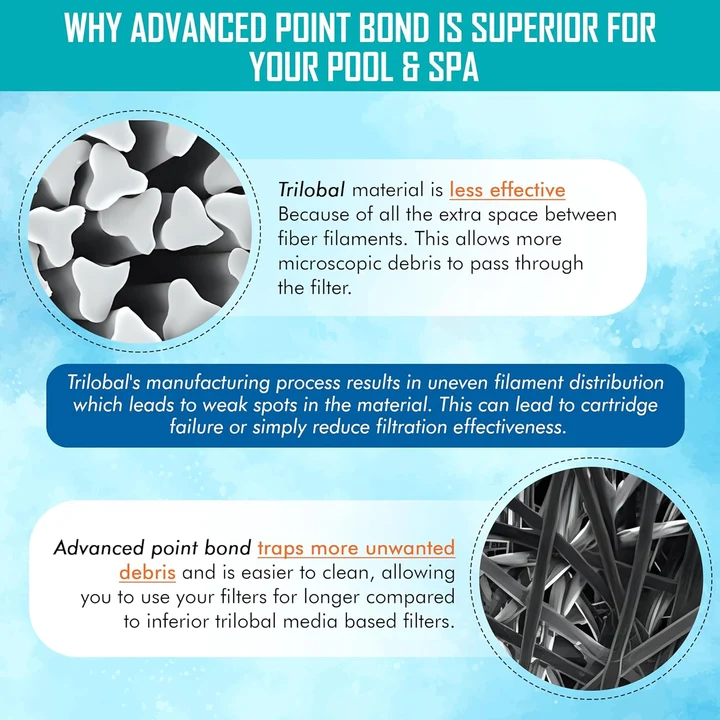
So yeah you are saving money on the cheaper filter but you are going to have to replace it more often and it is going to cause more strain on your pump. Also, good filters are point bonded with small strands. The filters have a maximum amount of weight they could have. But if small point bonded strands are used the more strands can be cross connected together making it harder for finer stuff to get through as there is more layers of strands cross connected. Kind of like a thick web. Where as cheap filters are flat bonded allowing for more stuff to go through, (not many layers of strands like a point bonded filter), more or less just like one layer.
Also the straps on a good filter are stronger and sturdier. The straps are very important because the straps hold the fabric (polyester) in place so it doesn't bunch up to together. The straps allow for all the pleats to be used. If some pleats bunch up together you are not using the entire filter, meaning less life you'll get out of it. Cheap filters straps aren't as sturdy and eventually give way and the fabric bunches up together.
Cartridge Filter Housings We Recommend
The cartridge filter housing we recommend is the Aquastar Pipeline Filter. It distributes the water being filtered throughout the whole entire filter cartridge so you do not have just one one area that is dirty. It uses the entire filter cartridge. Meaning the filter cartridge will last much longer. The Aquastar pipeline filter is considered efficient like a D.E. filter according to the NSF. Which is kind of like picking up the same amount of fine particles that a D.E. filter picks up but without having to reconstruct a D.E. filter when cleaning or handling D.E. powder.
The Aquastar comes with a Pleatco cartridge with no core, the core is the Aquastar filters core that comes with it. Which there core has a-lot more openings than any other core in the market. Also the water flow coming into the filter at the bottom of the filter is distributed evenly up the filter by the use of some tabs at the bottom of the filter that divert the water through out the entire filter.
Some people say these filters have been tested in commercial pools up to 90,000 gallons and they have worked great. Also some people say they only have to clean the filter every 6 months because of good they are. Unlike other cartridge filters where you have to clean them more or less every month. People rave about how clear the water gets with an aquastar filter. That is why we love them.